Publications
2027
-
DoubtBench: Does Self-Doubt Help Language Models—or Just Make Them Check?
Findings of the ACM International Conference on Web Search and Data Mining (WSDM) 2027, Hong Kong
Keywords—LLM evaluation, prompt engineering, metacognition, benchmark
CORE A Code Project PageAbstract
Prompts labeled “emotional” or “metacognitive” often mix self-doubt language with ordinary directives such as checking an answer or showing work. A performance change under such a compound prompt therefore does not isolate the cause. We introduce DoubtBench, a paired benchmark for attributing these effects. It contains 6,400 procedurally generated latent tasks spanning eight families and 33 types. Every task is evaluated under a paired 2 × 2 design over self-doubt wording and direct checking, plus a checking-plus-concision control, crossed with two task contexts, yielding ten paired responses per model–task pair. This isolates the effects of self-doubt-only wording, direct checking, their combination, concision, and existing requests for visible intermediate reasoning. The primary endpoint is the Conditional Doubt Effect (CDE)—the incremental accuracy change from adding self-doubt wording after direct checking is already present—together with a scorecard of competence, checking gain, context modulation, and robustness. Across 423,600 responses from six checkpoints, four foundation families, four seeds, and held-out surface forms, CDE ranges from −1.43 to +2.59 percentage points (three positive, three negative). Four of six checkpoints show positive incremental CDE under minimal requests, but only two do when intermediate reasoning is already requested. Thus, under the operationalization studied here, self-doubt wording is not a portable correction policy: its incremental effect beyond direct checking varies across checkpoints, task families, and existing instructions.
BibTeX
@inproceedings{ahuja2027doubtbench,
  title     = {DoubtBench: Does Self-Doubt Help Language Models---or Just Make Them Check?},
  author    = {Ahuja, Rishi and Dwivedi, Rajeev Ranjan and Kurmi, Vinod K.},
  booktitle = {Findings of WSDM 2027},
  year      = {2027},
  note      = {Accepted for publication}
}

2026
-
Query-Aware Token Budgeting for Efficient Late-Interaction Visual Document Retrieval
IEEE International Conference on Data Mining (ICDM) 2026
Keywords—visual document retrieval, late interaction, index compression, submodular selection
CORE A* PaperAbstract
Late-interaction visual document retrievers preserve fine-grained page evidence by storing many token embeddings per page, but the resulting storage and query-time interaction cost makes large-scale deployment expensive. A natural remedy is to pool document tokens before indexing, yet static pooling must decide which visual evidence to preserve before the query is known. This paper studies an alternative: use a heavily compressed index only for candidate generation, then perform query-aware token budgeting on the original token set for shortlisted pages. We formulate stage-two token selection as a budgeted MaxSim coverage problem, show that a clipped version is monotone submodular, and compare coverage-only, cluster-guided, token-wise, and marginal-gain selection policies. On ten ViDoRe tasks with ColModernVBERT, direct static pooling drops macro nDCG@5 from 0.6309 without compression to 0.4738 at a thirty-two-fold pool factor. Under the same candidate-generation regime and a pool-factor-eight-equivalent reranking budget, token top-k recovers 93.93 percent of the full-token score, while greedy marginal-gain selection recovers 98.39 percent. Held-out and leave-one-dataset-out evaluations show positive greedy improvements over token top-k on every dataset. Latency analysis identifies two useful operating points: token top-k for interactive retrieval and greedy selection as a quality upper envelope. The results show that late-interaction visual retrieval should be compressed by query-aware allocation, not only by query-agnostic pooling.
BibTeX
@inproceedings{rishi2026query, title = {Query-Aware Token Budgeting for Efficient Late-Interaction Visual Document Retrieval}, author = {PS Rishi and Rajeev Ranjan Dwivedi and Vinod K Kurmi}, booktitle = {IEEE International Conference on Data Mining (ICDM)}, year = {2026} } -
Rank-Guided Pseudo-Bias Learning for Robust Black-Box Adaptation
IEEE/CVF Conference on Computer Vision and Pattern Recognition (CVPR) 2026
Keywords—spurious correlations, black-box debiasing, foundation models, no group labels
CORE A* PaperAbstract
Pretrained vision encoders are widely used as frozen, black-box feature extractors, yet they often inherit spurious correlations that disproportionately harm underrepresented groups. We introduce PLD-Debias, a fully black-box debiasing framework that requires neither access to backbone parameters nor demographic annotations. Our method integrates three components: (1) Rank-Regularized Amplification, a lightweight adapter that exaggerates latent spurious directions; (2) Unsupervised Pseudo-Bias Induction, which clusters amplified features to infer high-fidelity proxy bias labels; and (3) Bias-Guided Refinement, combining supervised contrastive alignment with cluster-aware adaptive margins to purify representations and equalize decision boundaries. We theoretically show that these components jointly tighten a worst-group risk bound under spurious correlations. Empirically, PLD-Debias achieves state-of-the-art worst-group accuracy across CelebA, Waterbirds, and CMNIST, improving performance by 3–5 points over prior black-box methods while maintaining average accuracy. Remarkably, our pseudo-bias labels align with ground-truth bias annotations at over 90% fidelity, enabling oracle-level robustness without demographic supervision. Our results demonstrate that fairness and utility can be achieved through a plug-and-play classifier adapter for any frozen foundation model.
BibTeX
@inproceedings{dwivedi2026rank, title = {Rank-Guided Pseudo-Bias Learning for Robust Black-Box Adaptation}, author = {Rajeev Ranjan Dwivedi and Anshuman Dangwal and Vinod K Kurmi}, booktitle = {IEEE/CVF Conference on Computer Vision and Pattern Recognition (CVPR)}, year = {2026} } -
Regulating Internal Alignment Flows for Robust Learning Under Spurious Correlations
ICLR 2026 The Fourteenth International Conference on Learning Representations
Keywords—spurious correlations, worst-group accuracy, training regularizer, no group labels
CORE A* Project PageAbstract
Deep models often exploit spurious correlations such as backgrounds or dataset artifacts, hurting worst-group performance. We propose Alignment-Gated Suppression (AGS), a lightweight, plug-in regularizer that intervenes inside the network during training. AGS tracks a class-conditional, confidence-weighted contribution for each neuron, where more negative values indicate stronger support, and applies a percentile-based, multiplicative decay to the most extreme contributors. This reduces overconfident shortcut pathways while leaving other features relatively more influential. AGS integrates with standard ERM, requires no group labels, and adds <5% training overhead. We provide analysis linking AGS to minority-margin gains, path-norm-like capacity control, and stability benefits via EMA-smoothed gating. Empirically, AGS improves worst-group accuracy and calibration compared with ERM and is competitive with state-of-the-art methods across spurious-correlation benchmarks such as Waterbirds, CelebA, BAR, and COCO, while maintaining strong average accuracy. These results suggest that regulating internal alignment flow is a simple and scalable route to robustness without group labels.
BibTeX
@inproceedings{dwivedi2026regulating, title = {Regulating Internal Alignment Flows for Robust Learning Under Spurious Correlations}, author = {Rajeev Ranjan Dwivedi and Mohammedkaif Kalagond and Niramay M. Patel and Vinod K Kurmi}, booktitle = {International Conference on Learning Representations (ICLR)}, year = {2026} } -
Histogram Assisted Quality Aware Generative Model for Resolution Invariant NIR Image Colorization
Winter Conference on Applications of Computer Vision (WACV) 2026
Keywords—NIR-to-RGB colorization, image-to-image translation, generative models, Mamba
CORE A Project PageAbstract
We present HAQAGen, a unified generative model for resolution-invariant NIR-to-RGB colorization that balances chromatic realism with structural fidelity. The proposed model introduces (i) a combined loss term aligning the global color statistics through differentiable histogram matching, perceptual image quality measure, and feature-based similarity to preserve texture information, (ii) local hue-saturation priors injected via Spatially Adaptive Denormalization (SPADE) to stabilize chromatic reconstruction, and (iii) texture-aware supervision within a Mamba backbone to preserve fine details. We introduce an adaptive-resolution inference engine that further enables high-resolution translation without sacrificing quality. Our proposed NIR-to-RGB translation model simultaneously enforces global color statistics and local chromatic consistency, while scaling to native resolutions without compromising texture fidelity or generalization. Extensive evaluations on FANVID, OMSIV, VCIP2020, and RGB2NIR using different evaluation metrics demonstrate consistent improvements over state-of-the-art baseline methods. HAQAGen produces images with sharper textures, natural colors, attaining significant gains as per perceptual metrics. These results position HAQAGen as a scalable and effective solution for NIR-to-RGB translation across diverse imaging scenarios.
BibTeX
@inproceedings{abhinav2026histogram,
  title     = {Histogram Assisted Quality Aware Generative Model for Resolution Invariant NIR Image Colorization},
  author    = {Abhinav and Rajeev Ranjan Dwivedi and Samiran Das and Vinod K Kurmi},
  booktitle = {IEEE/CVF Winter Conference on Applications of Computer Vision (WACV)},
  year      = {2026}
}


2025
-
Multi-Attribute Bias Mitigation via Representation Learning
European Conference on Artificial Intelligence (ECAI) 2025
Keywords—multi-bias mitigation, fairness metrics, representation learning
CORE A Project PageAbstract
Real-world images frequently exhibit multiple overlapping biases, including textures, watermarks, gendered makeup, scene-object pairings, etc. These biases collectively impair the performance of modern vision models, undermining both their robustness and fairness. Addressing these biases individually proves inadequate, as mitigating one bias often permits or intensifies others. We tackle this multi-bias problem with Generalized Multi-Bias Mitigation (GMBM), a lean two-stage framework that needs group labels only while training and minimizes bias at test time. First, Adaptive Bias-Integrated Learning (ABIL) deliberately identifies the influence of known shortcuts by training encoders for each attribute and integrating them with the main backbone, compelling the classifier to explicitly recognize these biases. Then Gradient-Suppression Fine-Tuning prunes those very bias directions from the backbone’s gradients, leaving a single compact network that ignores all the shortcuts it just learned to recognize. Moreover we find that existing bias metrics break under subgroup imbalance and train-test distribution shifts, so we introduce Scaled Bias Amplification (SBA), a test-time measure that disentangles model-induced bias amplification from distributional differences. We validate GMBM on FB-CMNIST, CelebA, and COCO, where we boost worst-group accuracy, halve multi-attribute bias amplification, and set a new low in SBA, even as bias complexity and distribution shifts intensify, making GMBM the first practical, end-to-end multi-bias solution for visual recognition.
BibTeX
@inproceedings{dwivedi2025multi, title = {Multi-Attribute Bias Mitigation via Representation Learning}, author = {Rajeev Ranjan Dwivedi and Ankur Kumar and Vinod K Kurmi}, booktitle = {European Conference on Artificial Intelligence (ECAI)}, year = {2025} } -
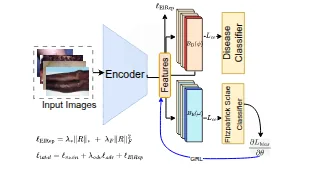
Equitable Dermatology: Adversarial and Spectral Techniques for Fair Skin Lesion Classification
Indian Conference on Computer Vision, Graphics and Image Processing (ICVGIP) 2025
Keywords—medical imaging, skin-tone fairness, adversarial debiasing
Abstract
Deep learning models for skin-lesion classification often underperform on darker skin tones, leading to diagnostic inequity. We propose a unified framework that combines adversarial debiasing via a Gradient Reversal Layer to remove skin-tone information from feature representations and an Elastic Representation (ElRep) regularizer to learn robust, disentangled lesion features. By jointly optimizing lesion classification and skin-tone prediction losses, our composite objective encourages the encoder to focus on lesion morphology rather than background. Evaluated on the large-scale Fitzpatrick-17k and ISIC2020 datasets, our approach achieves significant improvement in overall accuracy and worst-group accuracy over standard empirical risk minimization, while maintaining fast and stable convergence. Qualitative t-SNE and Grad-CAM analyses confirm that our model learns lesion-focused embeddings across all skin types, offering a practical, reproducible path toward more equitable AI-driven dermatology.
BibTeX
@inproceedings{dwivedi2025equitable, title = {Equitable Dermatology: Adversarial and Spectral Techniques for Fair Skin Lesion Classification}, author = {Rajeev Ranjan Dwivedi and Mohammedkaif Rafiq Kalagond and Monika Sharma and Amit Sangroya}, booktitle = {Indian Conference on Computer Vision, Graphics and Image Processing (ICVGIP)}, year = {2025} } -
Grad-CL: Source Free Domain Adaptation with Gradient Guided Feature Disalignment
British Machine Vision Conference (BMVC), 2025
Keywords—source-free domain adaptation, medical image segmentation, contrastive learning
CORE A arXivAbstract
Accurate segmentation of the optic disc and cup is critical for the early diagnosis and management of ocular diseases such as glaucoma. However, segmentation models trained on one dataset often suffer significant performance degradation when applied to target data acquired under different imaging protocols or conditions. To address this challenge, we propose Grad-CL, a novel source-free domain adaptation framework that leverages a pre-trained source model and unlabeled target data to robustly adapt segmentation performance without requiring access to the original source data. Grad-CL combines a gradient-guided pseudolabel refinement module with a cosine similarity based contrastive learning strategy. In the first stage, salient class-specific features are extracted via a gradient-based mechanism, enabling more accurate uncertainty quantification and robust prototype estimation for refining noisy pseudolabels. In the second stage, a contrastive loss based on cosine similarity is employed to explicitly enforce inter-class separability between the gradient-informed features of the optic cup and disc. Extensive experiments on challenging cross-domain fundus imaging datasets demonstrate that Grad-CL outperforms state-of-the-art unsupervised and source-free domain adaptation methods, achieving superior segmentation accuracy and improved boundary delineation.
BibTeX
@inproceedings{thakur2025grad,
  title     = {Grad-CL: Source Free Domain Adaptation with Gradient Guided Feature Disalignment},
  author    = {Rini Smita Thakur and Rajeev Ranjan Dwivedi and Vinod K Kurmi},
  booktitle = {British Machine Vision Conference (BMVC)},
  year      = {2025}
}


2024
-
CosFairNet: A Parameter-Space based Approach for Bias Free Learning
British Machine Vision Conference (BMVC), (2024)
Keywords—bias mitigation, parameter-space debiasing, image classification
CORE A Project PageAbstract
Deep neural networks trained on biased data often inadvertently learn unintended inference rules, particularly when labels are strongly correlated with biased features. Existing bias mitigation methods typically involve either a) predefining bias types and enforcing them as prior knowledge or b) reweighting training samples to emphasize bias-conflicting samples over bias-aligned samples. However, both strategies address bias indirectly in the feature or sample space, with no control over learned weights, making it difficult to control the bias propagation across different layers. Based on this observation, we introduce a novel approach to address bias directly in the model's parameter space, preventing its propagation across layers. Our method involves training two models, a bias model for biased features and a debias model for unbiased details, guided by the bias model. We enforce dissimilarity in the debias model's later layers and similarity in its initial layers with the bias model, ensuring it learns unbiased low-level features without adopting biased high-level abstractions. By incorporating this explicit constraint during training, our approach shows enhanced classification accuracy and debiasing effectiveness across various synthetic and real-world datasets of different sizes. Moreover, the proposed method demonstrates robustness across different bias types and percentages of biased samples in the training data.
BibTeX
@inproceedings{dwivedi2024cosfairnet, title = {CosFairNet: A Parameter-Space based Approach for Bias Free Learning}, author = {Rajeev Ranjan Dwivedi and Priyadarshni Kumari and Vinod K Kurmi}, booktitle = {British Machine Vision Conference (BMVC)}, year = {2024} } -
Quantifying Uncertainty in Neural Networks through Residuals
33rd ACM International Conference on Information and Knowledge Management (CIKM), (2024)
Keywords—uncertainty estimation, Gaussian processes, regression
CORE A Project PageAbstract
Regression models are of fundamental importance in explicitly explaining the response variable in terms of covariates. Heteroscedasticity is common in most real-world scenarios and is hard to model due to its randomness. The Gaussian process generally captures epistemic (model) uncertainty but fails to capture heteroscedastic aleatoric uncertainty. The framework of Heteroscedastic Gaussian Process (HetGP) inherently captures both epistemic and aleatoric by placing independent Gaussian processes on both mean function and error term. In this work, we propose the posthoc HetGP on the residuals of the trained neural network to obtain both epistemic and aleatoric uncertainty. The advantage of posthoc HetGP on residuals is that it can be extended to any type of model, since the model is assumed to be black-box that gives point predictions. We demonstrate our approach through simulation studies on UCI regression datasets.
BibTeX
@inproceedings{dalavi2024quantifying,
  title     = {Quantifying Uncertainty in Neural Networks through Residuals},
  author    = {Udhbav Dalavi and Rini Smita Thakur and Rajeev Ranjan Dwivedi and Vinod K Kurmi},
  booktitle = {ACM International Conference on Information and Knowledge Management (CIKM)},
  year      = {2024}
}


2023
-
Predicting Missing Light Curves of Gamma-Ray Bursts with Bidirectional-LSTM: An Approach for Enhanced Analysis
Accepted at SPAICE, 24 ECSAT, UK
Keywords—astrophysics, time series, BiLSTM, missing-data reconstruction
arXivAbstract
Gamma-ray bursts (GRB) are powerful transient events that emit a large output of gamma rays within a few seconds. Studying these short bursts is vital for cosmological research since they originate from sources observed at large redshifts. To effectively carry out these studies, it is crucial to establish a correlation between the observable features of GRBs while reducing their uncertainty. For these reasons, a comprehensive description of the general GRB light curve (LC) would be crucial for the studies. However, unevenly spaced observations and significant gaps in the LC, which are primarily unavoidable for various reasons, make it difficult to characterize GRBs. Therefore, the general classification of GRB LCs remains challenging. In this study, we present a novel approach to reconstruct gamma-ray burst (GRB) light curves using bidirectional Long Short-Term Memory (BiLSTM). Experimental results show that the BiLSTM approach performs better than traditional methods and produces smoother and more convincing reconstructions for GRBs.
BibTeX
@inproceedings{sourav2024predicting,
  title     = {Predicting Missing Light Curves of Gamma-Ray Bursts with Bidirectional-LSTM: An Approach for Enhanced Analysis},
  author    = {Shashwat Sourav and Amit Shukla and Rajeev Ranjan Dwivedi and Kartikey Singh},
  booktitle = {SPAICE: AI in and for Space},
  year      = {2024}
}

* Equal contribution. Shaded: CORE A*. CORE ranks from the CORE conference portal.